





Basic information
Tours of the Chapel for the public are possible only by prior arrangement.
Briefly to the origin
It is the middle of the 15th century, when townhouses were built in Olomouc on the site of the old Jewish quarter with a synagogue. They are adjacent to the Renaissance convent of the University of Olomouc, which the Jesuits, the Society of Jesus, founded in 1573.
Between 1660 and 1668, the Jesuits built the so-called Old Convict, or residence for aristocratic and patrician students, on the site of the redeemed houses.
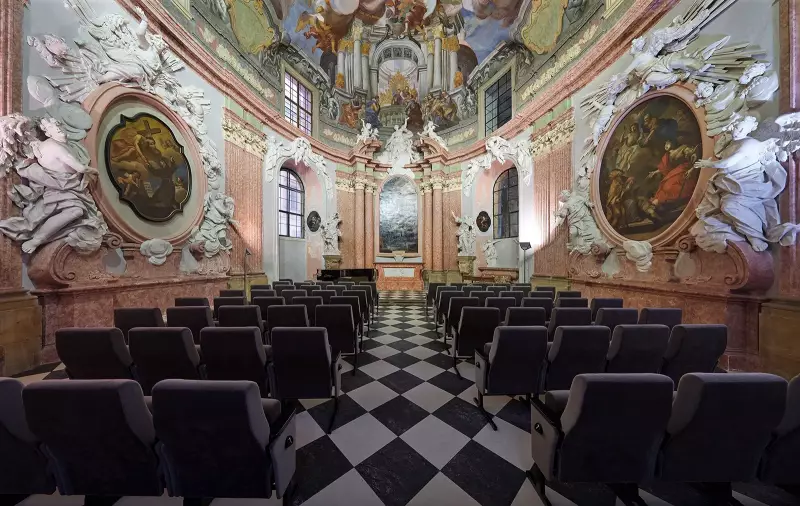
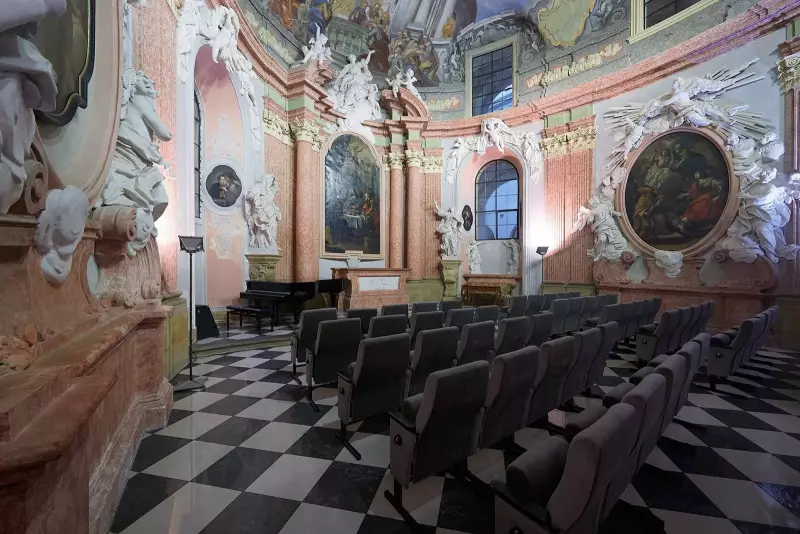
Between 1721 and 1724, a so-called new convent is built next to the old convent, probably on the site of the old synagogue. It includes the late Gothic Jewish Gate of the city and a new oval chapel of the Corpus Christi on the site of the Gothic chapel of the same dedication. The Baroque chapel was designed and built by the Olomouc builder Jan Jakub Kniebandl.
Inspiration from Rome
The architecture of the Corpus Christi Chapel has the power to captivate the visitor with its interior design. Its model was the transverse oval church of the Jesuit novices of Sant’Andrea al Quirinale in Rome (1658-1670) by the leading Roman architect, sculptor and painter Gian Lorenzo Bernini.
The Body of the Lord
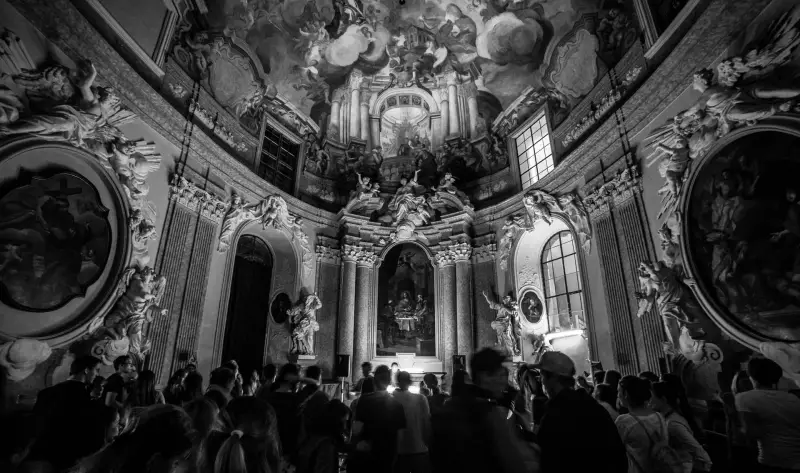
The chapel stands on the plan of a longitudinal oval with an obvious eucharistic reference to the shape of the host, the Body of the Lord. The form of the high altar, with its clustered columns and multiplied pilasters on the sides, is based on the high altar of the Roman church.
Faith, Hope, Love
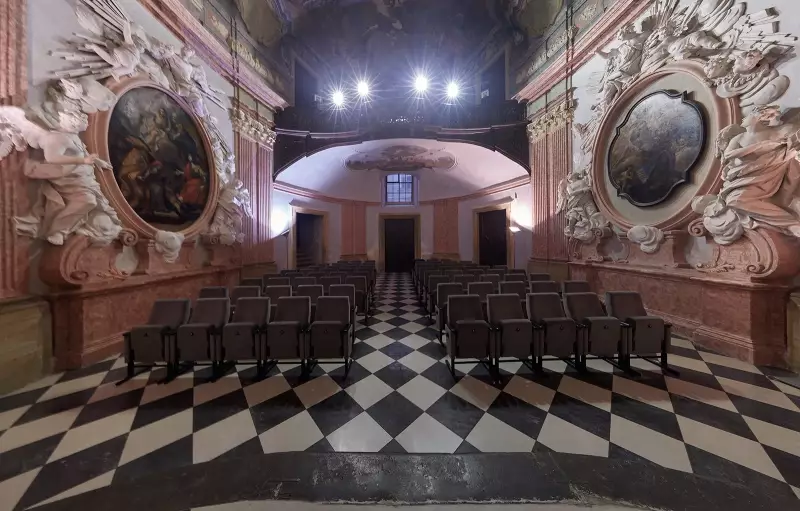
The sculptural and stucco decoration of the chapel is dominated by a triangle of female statues (at the top and sides of the main altar), which personify the main Christian virtues – Faith, Hope and Love. Like the angels and cherubs (above the main altar and on the frames of the side altars), these imposing symbols are the work of the Olomouc sculptor Filip Sattler (1695-1738).
Battle with the Tatars and the Supper in Emmaus
The overarching female figure above the altar retable is perfectly in keeping with the statue of St. Andrew above the high altar of Bernini’s church in its placement and gesture. The vault also opens to the celebration of the Body of the Lord with a ceiling painting depicting the legendary, but historically unproven, victory of Jaroslav of Šternberk over the Tatars at Olomouc (allegedly on 24 June 1241). It was painted in 1728 by the leading Olomouc painter Jan Kryštof Handke (1694-1774), as was the altarpiece of the Supper at Emmaus.
The Holy Trinity – that is, God the Father, the dove of the Holy Spirit, and Christ, represented by the Lamb on the Cross, who rests in the cosmic sphere – appears on the vault in the open heavens. Our Lady of Victory herself then shows the complete Trinity by the shining Sternberg eight-pointed star, which is held in the hands of an angel, directly above the model of the Church of the Assumption in Olomouc. It was in this church that Jaroslav of Šternberk received the Host (the scene above the altar) from the hands of a priest, which was to lead to the miraculous victory over the Tartars.
The angels, led by St. Michael the Archangel, head towards the night camp of the Tartars on the opposite side of the vault, with flaming swords in their hands. They are ready to intervene on behalf of Sternberg’s approaching army. The depiction of the anxious Tartars in Turkish turbans updates the enduring danger of Turkish wars. At the same time, it is a reminder of the ancient merits of the Olomouc people in the case of the defence of the empire, with a hopeful reminder of Prince Eugene of Savoy’s last victory over the Turks – the capture of Belgrade in 1717.
Cultural monument
Despite the fact that all the buildings of the former Jesuit Convent were used by the army for 200 years, the Corpus Christi Chapel has remained almost untouched. It has remained an exceptionally preserved and later carefully restored space, a protected cultural monument. Since 2002, the UP Art Centre has used it as a unique concert or conference hall. The Corpus Christi Chapel is consecrated and open to the public by prior arrangement with the manager of the UC UP.